Routledge Handbook of Human-animal Studies by McHugh Susan. Marvin Garry
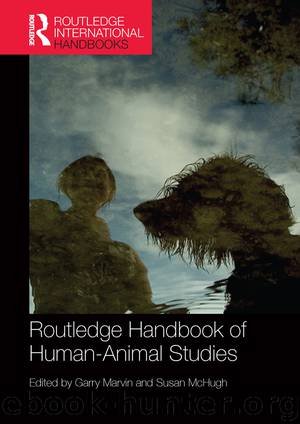
Author:McHugh, Susan.,Marvin, Garry.
Language: eng
Format: epub
ISBN: 9781136237874
Publisher: Taylor & Francis Ltd
Conclusion
It is possible that almost any of the introduced feral animals could have become Australia’s bête noire, so why was the feral cat singled out for special treatment, meaning largely hated, even more than the cane toad? I think there are three main reasons.
First, there is something about the feral cat’s ‘social character’, as apprehended by Australians, that makes it seem treacherous. As a recipient and repository of familial love and affection, the cat becomes a domestic insider. Yet that apparent social bond of valued interde-pendence is illusory because cats can and do choose to leave in order to live independently of humans. They are therefore apt creatures to represent a very feared social figure: a person whose loyalties are uncertain and unproven, one who might be let in but not join in; one who enacts division and fragmentation; and one who therefore questions and challenges the idea of a beleaguered Australian culture, with its monolithic values always potentially undermined by the arrival of others.
Second, the feral cat may be singled out because of its unique physical apprehension. Of all the introduced animals capable of living wild (with the exception of the cane toad), the cat is singular in that it lives and hunts within and around human settlements, particularly because of the omnipresence of mice and rats. Feral cats are very visible and noted predators, not so obviously of nocturnal pest creatures as of native birds, who are active during daylight hours and present in elevated numbers owing to the human habit of planting and watering extensive areas of native flowering plants. In the absence of native carnivores, banished by humans from their towns and cities, the cat stands out as the main killer of the natural jewels of city gardens and parks.
Third, the cat may also be the victim of vaguely remembered but longstanding historical beliefs about their association with dark, magical, and pagan forces (see Holmberg in this volume).
The national myth of Australia began with a small population of mostly British origin occupying a vast landmass close to heavily populated Asian countries. They feared being culturally annihilated through migration and social fragmentation. Maintaining Australianness was a survival strategy and upholding it through purification, filiation, and closure became a very significant guiding principle. Britain was the opposite, a dense population occupying a small island that had established a stable sense of nation and place in the world. Its success had been built on hybridization, alliance, and civil liberty, and these also became generalized guiding principles. Between the two, Australia and Britain illustrate the range of social processes of designation, treatment, and impact of feral animals in contemporary societies, and show how they relate strongly to historical, social, and cultural features of their respective societies.
Download
This site does not store any files on its server. We only index and link to content provided by other sites. Please contact the content providers to delete copyright contents if any and email us, we'll remove relevant links or contents immediately.
Sapiens: A Brief History of Humankind by Yuval Noah Harari(14389)
The Tidewater Tales by John Barth(12659)
Mastermind: How to Think Like Sherlock Holmes by Maria Konnikova(7347)
The Thirst by Nesbo Jo(6944)
Do No Harm Stories of Life, Death and Brain Surgery by Henry Marsh(6941)
Why We Sleep: Unlocking the Power of Sleep and Dreams by Matthew Walker(6725)
Life 3.0: Being Human in the Age of Artificial Intelligence by Tegmark Max(5558)
Sapiens by Yuval Noah Harari(5370)
The Body: A Guide for Occupants by Bill Bryson(5096)
The Longevity Diet by Valter Longo(5064)
The Rules Do Not Apply by Ariel Levy(4969)
The Immortal Life of Henrietta Lacks by Rebecca Skloot(4588)
Animal Frequency by Melissa Alvarez(4473)
Why We Sleep by Matthew Walker(4446)
The Hacking of the American Mind by Robert H. Lustig(4383)
Yoga Anatomy by Kaminoff Leslie(4363)
All Creatures Great and Small by James Herriot(4322)
Double Down (Diary of a Wimpy Kid Book 11) by Jeff Kinney(4272)
Embedded Programming with Modern C++ Cookbook by Igor Viarheichyk(4179)
